National Treasure
Nyoraidō
1748 (the middle of the Edo Period)
Five-bay long structure
Four-Bay Transverse Span
Single-story with a pent roof
hip-and-gable style (irimoya-zukuri)
Pent roof rear has a gable with the roof swept down
Pent roof front is three bays wide
Eaves fitted with a cusped gable
tiled roof (hongawarabuki)
This article can be read in about 2 minutes.
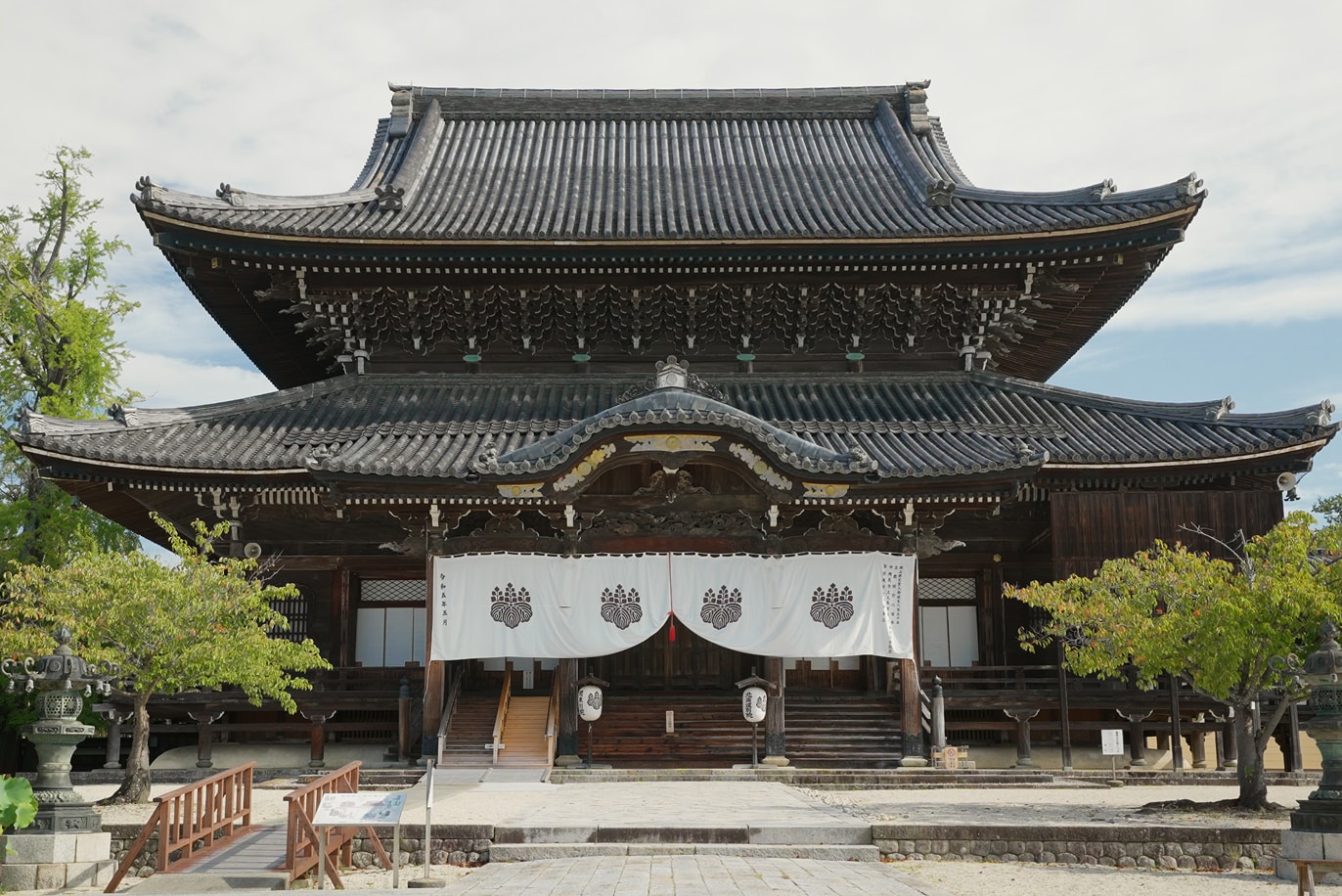
Amidst the stillness,
the beauty of master craftsmanship lives on
The Nyoraidō is the primary worship hall of Senjuji and houses the main object of worship, a statue of Amida Nyorai from which it gets its name. Amida Nyorai is also known as the Buddha of Infinite Light and Life and is the principle deity of Jōdō Shinshū Buddhism. Believers chant the nenbutsu, “Hail the Buddha of Infinite Light (namu-amida-butsu),” which expresses both belief in and gratitude to Amida Nyorai.
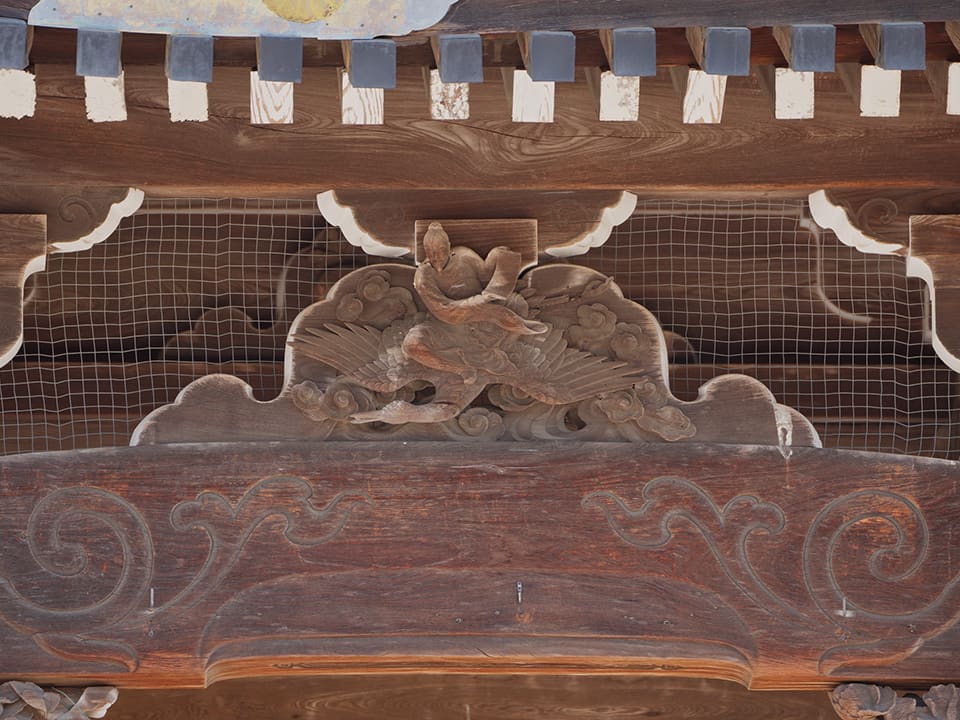
Unlike the Mieidō, the Nyoraidō is built in a Zen architectural style and is about half the size. However, it is just as tall as the Mieidō. The Nyoraidō’s architectural features indicate its importance as the main hall of Senjuji. The curved gable over the entrance and the pent roof that skirts the middle of the structure were difficult and costly to build in the eighteenth century, when the hall was constructed. Underneath the eaves of the hip-and-gable roof are detailed carvings. For example, the cranes under the east and west gables of the Nyoraidō are so lifelike that they are said to have just taken flight after visiting the pond behind the Nyoraidō.
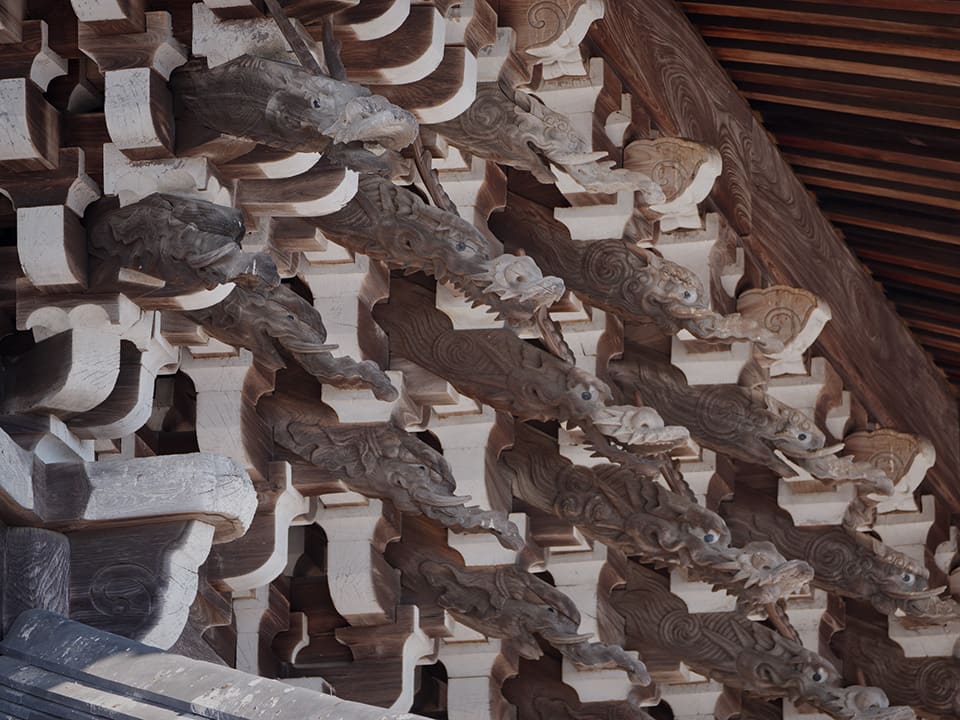
The large, tiled roof is quite heavy, and the upper roof is supported in part by an assembly of layered brackets between the two roofs. The ends of these brackets are carved into the shape of dragons. The mouths of the dragons alternate—open and closed. This is an expression of the first and last sounds of the Japanese syllabary, “ah” and “un,” representing the beginning and end of all things. In addition to dragons, elephants (spiritually significant in Buddhism) and baku (mythical animals that are thought to eat metal, thus preventing war) have been carved into the brackets.
The principal object of worship is a standing wooden sculpture of Amida Nyorai covered in gold leaf. It is the work of Kaikei (dates unknown), a leading artist of the Kei school of Buddhist sculpture who was active around the turn of the thirteenth century. On transoms above the image of Amida are three panels depicting swirling gold clouds. Floating and flying between the clouds are birds and numerous musical instruments including a flute, taiko drum, and conch shell. On the transoms running perpendicular to the altar are detailed carvings of animals, such as a monkey, rabbit, horse, and tiger.
Construction of the Nyoraidō took about thirty years in total, due in large part to the time it took to raise enough money to complete the project. Building began in 1719 and continued steadily for six years before stalling due to a lack of funds. Work began again in 1740, and the hall was finally completed in 1748. In contrast to the Mieidō, the Nyoraidō was built by local craftsmen and financed by lay people. The temple still has all the records of the construction process, from initial plans to the purchase of the materials, as well as a complete list of donors and their contributions.
frog-leg strut (kaerumata)
It is a part, both sides of which widen towards the bottom with curves, like a frog opening its legs (kaeru means a frog, and mata means crotch) and is located between two connecting beams. Otherwise, its name reportedly derives from karimata, the shape of the arrowhead, the edge of which splits into two.
elephant/dragon/tapir
Share on Social Media


Please respond to our questionnaire.
Estimated length: 30 seconds